Payroll operations
Taxable benefits and payroll deductions in Canada, province by province
Most payrolls carry more than salary: a phone allowance, a bonus, RRSP contributions, union dues. PayHr now keeps these on each employee’s Benefits & deductions page, set once and applied to payrolls on their own schedule. This guide covers how CRA treats what you add, what to watch when you deduct, and how it works in PayHr.
What you can add and deduct
Open an employee and choose Benefits & deductions. Add to pay covers a taxable cash benefit or allowance, a taxable non-cash benefit, a non-taxable reimbursement or allowance, a bonus, retroactive pay and commission. Deduct from pay covers employee RPP and RRSP contributions, union dues and other after-tax deductions.
Each item has a pay stub label, an amount, a Starting payday and how often it’s paid: Once, Every pay or Every month (the first regular payroll paid in each calendar month). Regular payrolls apply items automatically, and a one-time item is paid on the next payroll that includes the employee.
How CRA treats benefits and allowances
CRA’s guide T4130 sets the rules. When a cash benefit is taxable, it is also pensionable and insurable. A taxable non-cash benefit is pensionable but generally not insurable. That’s why PayHr starts taxable benefits with Benefit CPP on and Benefit EI on for cash only, and reports them under T4 code 40 (other taxable benefits) unless you choose another code, such as 30 for board and lodging or 34 for an automobile.
The value of a benefit is generally its fair market value, and you may have to include the GST/HST you paid and any PST. You don’t include GST/HST for cash remuneration such as salary, wages and allowances. A reasonable reimbursement of business expenses isn’t income for the employee, while an allowance is generally taxable unless it’s based on a reasonable per-kilometre rate. When you’re unsure, check the T4130 benefits chart.
What to check before you deduct
Income tax, CPP and EI are deductions the law requires. Almost everything else, from union dues to a parking charge, depends on your province’s employment standards, and most require the employee’s agreement, usually in writing. Keep a signed authorization with the employee’s documents before you add a deduction. For RPP and RRSP contributions and union dues, More options lets you choose whether the deduction comes from regular pay or from a bonus or retroactive payment.
Changing and stopping items
Use Edit to change an amount or start date. Once a payroll has paid an item, its type and how often it’s paid stay fixed: stop it and add a new one instead. Stop ends an item from the payday you choose, and payrolls already approved keep it. Stopped items and paid one-time items move to Expired, so the page keeps a record of what applied and when.
Dental coverage and pension plan details for the T4 (boxes 45 and 50) are a separate setting on the employee’s Pay page.
Sales tax and deduction rules by province
GST/HST rates are from CRA’s GST/HST rates table; provincial sales tax rates are from each province. The deduction rules are general employment-standards rules; a collective agreement can add others, and federally regulated employers follow the Canada Labour Code.
Jump to: Alberta · British Columbia · Manitoba · New Brunswick · Newfoundland and Labrador · Nova Scotia · Northwest Territories · Nunavut · Ontario · Prince Edward Island · Saskatchewan · Yukon
Alberta
- GST is 5% and there’s no provincial sales tax. Include any GST/HST you paid in the value of a non-cash taxable benefit.
- You can deduct from earnings when the law requires it, a collective agreement allows it, or the employee authorized it in writing.
Source: Alberta deductions from earnings
British Columbia
- GST is 5% and PST is generally 7%. A non-cash benefit’s value may have to include both.
- You may only deduct from wages when you’re legally required to, or the employee approves the deduction in writing.
Source: BC deductions from wages
Manitoba
- GST is 5% and the general retail sales tax is 7%. A non-cash benefit’s value may have to include both.
- Deductions are allowed when required by law, for something the employee agrees to pay for that directly benefits them, or for cash advances and payroll errors.
Source: Manitoba deductions from wages
New Brunswick
- HST is 15%. Include any GST/HST you paid in the value of a non-cash taxable benefit.
- The Act doesn’t set out when you may deduct from wages. New Brunswick asks employers to contact the Employment Standards Branch before any deduction that isn’t required by law.
Source: New Brunswick rules on payment
Newfoundland and Labrador
- HST is 15%. Include any GST/HST you paid in the value of a non-cash taxable benefit.
- Allowed deductions include a group benefit plan the employee participates in and savings plans. Cash shortages, bad cheques and charge cards can’t be deducted.
Source: Your Rights at Work (NL)
Nova Scotia
- HST dropped to 14% on April 1, 2025. Include any GST/HST you paid in the value of a non-cash taxable benefit.
- Deductions beyond statutory, court-ordered and benefit-plan ones need a clear agreement with the employee, and can’t take gross wages below minimum wage.
Source: Nova Scotia deductions from pay
Northwest Territories
- GST is 5% and there’s no territorial sales tax.
- You need a written authorization signed by the employee for any other deduction, and the employee must receive a direct benefit from it.
Source: NWT employment standards FAQ
Nunavut
- GST is 5% and there’s no territorial sales tax.
- You may honour an employee’s written assignment of wages for set purposes, such as insurance coverage or a pension plan.
Source: Nunavut Labour Standards Act, section 51
Ontario
- HST is 13%. Include any GST/HST you paid in the value of a non-cash taxable benefit.
- Beyond deductions the law requires, the employee must sign a written authorization that states the amount or how to calculate it.
Source: Ontario ESA guide: payment of wages
Prince Edward Island
- HST is 15%. Include any GST/HST you paid in the value of a non-cash taxable benefit.
- Authorized deductions include a group benefit plan, a savings plan at the employee’s request, and anything the employee authorizes in writing.
Source: PEI Employment Standards Act
Saskatchewan
- GST is 5% and PST is 6%. A non-cash benefit’s value may have to include both.
- Permitted deductions include employee contributions to pension, RRSP or other benefit plans, voluntary charitable donations and wage advances.
Source: Saskatchewan payroll deductions
Yukon
- GST is 5% and there’s no territorial sales tax.
- You can’t withhold, deduct or offset an employee’s earnings for any reason without their written authorization.
Provincial rules shown are general employment-standards minimums for the date published. Check the linked official source for your situation. PayHr supports every province and territory except Quebec.
Add a benefit or deduction
Open your PayHr workspace, choose an employee, then Benefits & deductions. Questions? Write to us.
Keep reading

Payroll workflows
Excel vs free payroll software in Canada: when to switch
Compare a Canadian payroll spreadsheet with free payroll software: review time, employee records, corrections, payment tasks and the cost of each payday.
Read the guide
Pay schedules
Biweekly vs semi-monthly payroll in Canada: 26 vs 24 pay periods
Understand biweekly and semi-monthly payroll, compare a salary example, and plan Canadian pay dates, timesheet cutoffs and payroll funding.
Read the guide
Payroll setup
Switching payroll software mid-year in Canada: a practical checklist
Plan a Canadian payroll software switch with year-to-date records, a clear cutover date, payment reconciliation and a first-run review checklist.
Read the guide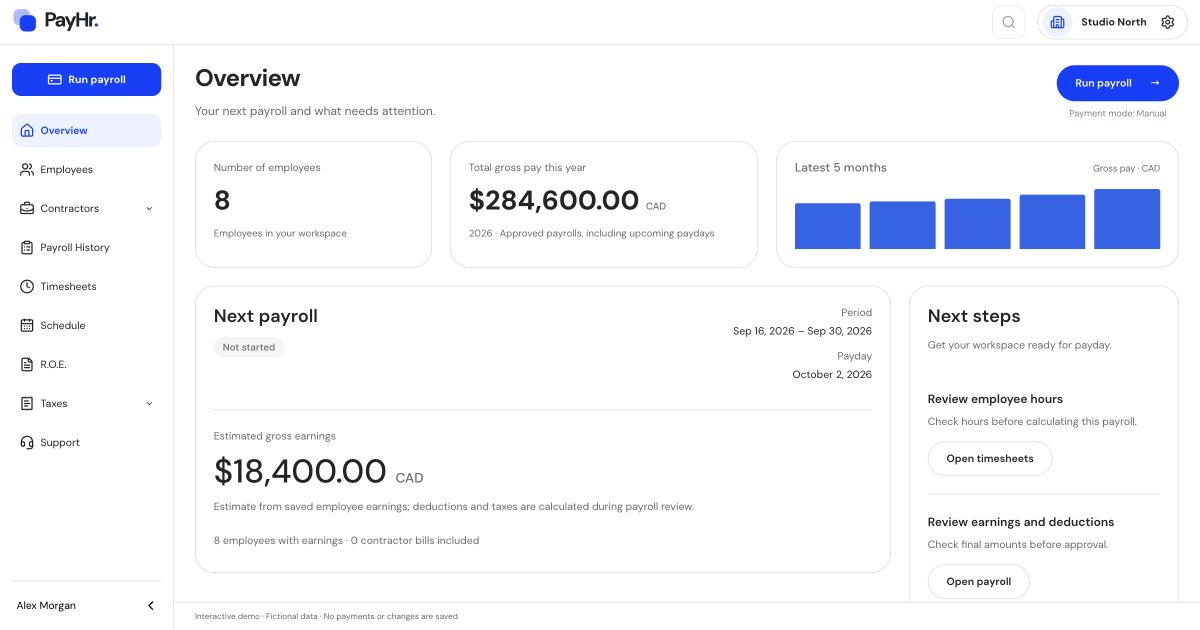
Company news
PayHr introduces a free payroll software plan for Canadian small businesses
PayHr’s Free Plan includes unlimited employees, contractors and pay runs, with optional paid services and coverage in Canadian provinces outside Quebec.
Read the announcement