Payroll operations
How to run payroll in Canada, step by step, with provincial tax
A pay run turns saved hours and salaries into pay statements, deductions and a CRA remittance. This guide walks through each step in PayHr, what to check on the payroll record, and how the employee’s province changes the income tax on every cheque.

Before you start
- Your pay schedule set, so the period and payday are filled in for you
- Employees added with their pay rate, province of employment and TD1 claim amounts
- Timesheets saved for hourly employees for every day in the period
- Earlier pay this year for anyone you paid outside PayHr, so CPP, CPP2 and EI maximums are tracked
- Your CRA remittance schedule confirmed in workspace settings, so due dates show
The four steps
- Pay period: check the period start, period end and payday. Edit dates changes them for this run only. The payday decides the tax year, the year-to-date totals the pay joins and when the remittance is due.
- Employees: everyone with pay this period is included by default. Hourly pay comes from saved timesheets (overtime at 1.5 times, double time at 2 times), and salaried employees get their annual salary divided by the pay periods in the year. Select Calculate payroll.
- Review: the payroll record shows the total payroll cost and, for each person, gross pay, deductions, employer contributions and net pay.
- Approved: select Approve payroll, check the amount to pay and the payment mode, and confirm.
What’s on the payroll record
Deductions are withheld from the employee: CPP, CPP2, EI, federal income tax and provincial or territorial income tax. Employer contributions are what you pay on top: CPP and CPP2 matching the employee’s, and EI at 1.4 times the employee’s premium at the standard rate. PayHr tracks year-to-date amounts, so CPP, CPP2 and EI stop once a yearly maximum is reached.
Deductions and contributions totals each type and shows the CRA remittance for this payroll with its due date, which depends on your remitter type. Select any row to preview a draft pay statement, and use Download for the payroll register as a Summary PDF, Excel or CSV.
Edit, recalculate, approve
Until you approve, everything can change. Edit pay run returns to the employee step, and Recalculate reruns the same payroll with current data after you fix a timesheet or an employee’s pay. If anything changed since the calculation, PayHr asks you to calculate again, so the approved record always matches what you reviewed.
Approval records the payroll: it finalizes pay statements, adds the amounts to year-to-date totals for T4s, records vacation pay and locks the period’s timesheet dates. With Manual Pay, it doesn’t move money. You pay employees through your bank and remit to the CRA yourself, then track each payment in PayHr. The run payroll help guide covers every screen, and the narrated tutorial shows a complete pay run.
Provincial income tax on each payroll
These are the CRA’s July 2026 payroll figures for each province and territory: the lowest income tax rate and the basic personal amount used when an employee hasn’t claimed more on their provincial TD1. Higher income is taxed at higher rates. Quebec runs its own system and isn’t covered by PayHr.
Jump to: Alberta · British Columbia · Manitoba · New Brunswick · Newfoundland and Labrador · Nova Scotia · Northwest Territories · Nunavut · Ontario · Prince Edward Island · Saskatchewan · Yukon
Alberta
- Alberta income tax starts at 8%, with a basic personal amount of $22,769 for 2026.
- It appears as its own provincial line under Deductions and contributions, next to federal tax.
Source: CRA payroll deductions formulas (T4127), July 2026
British Columbia
- BC raised its lowest rate to 5.60% for 2026. To make up for the first half of the year, payrolls from July use a prorated 6.14%.
- The basic personal amount is $13,216, and the BC tax reduction is prorated to $805 for the rest of 2026.
Source: CRA payroll deductions formulas (T4127), July 2026
Manitoba
- Manitoba income tax starts at 10.8%, and the provincial basic personal amount is worked out with Manitoba’s own formula.
- No Manitoba changes took effect on July 1, 2026.
Source: CRA payroll deductions formulas (T4127), July 2026
New Brunswick
- New Brunswick income tax starts at 9.4%, with a basic personal amount of $13,664 for 2026.
Source: CRA payroll deductions formulas (T4127), July 2026
Newfoundland and Labrador
- The 2026 basic personal amount rose to $13,094. Payrolls from July use a prorated $15,000 to catch up.
- Employees who gave you a TD1NL with the old amount don’t need a new one. Income tax starts at 8.7%.
Source: CRA payroll deductions formulas (T4127), July 2026
Nova Scotia
- Nova Scotia income tax starts at 8.79%, with a basic personal amount of $11,932 for 2026.
Source: CRA payroll deductions formulas (T4127), July 2026
Northwest Territories
- Territorial income tax starts at 5.9%, with a basic personal amount of $18,198.
- The 2% NWT payroll tax is withheld from pay and remitted to the GNWT, so PayHr keeps it out of your CRA remittance.
Territorial income tax figures are from the CRA’s July 2026 payroll deductions formulas (T4127).
Source: NWT payroll tax for employees
Nunavut
- Territorial income tax starts at 4%, with a basic personal amount of $19,659.
- Nunavut payroll tax is 2% of taxable pay for employees who normally work in Nunavut. It’s remitted to the territory, not the CRA.
Source: CRA payroll deductions formulas (T4127), July 2026
Ontario
- Ontario income tax starts at 5.05%, with a basic personal amount of $12,989.
- The Ontario Health Premium is withheld with provincial tax on annual income over $20,000.
Source: CRA payroll deductions formulas (T4127), July 2026
Prince Edward Island
- PEI added a tax bracket for income over $200,000 in 2026. Payrolls from July use a prorated 21% on that portion.
- Income tax starts at 9.5%, with a basic personal amount of $15,000.
Source: CRA payroll deductions formulas (T4127), July 2026
Saskatchewan
- Saskatchewan income tax starts at 10.5%, with a basic personal amount of $20,381 for 2026.
Source: CRA payroll deductions formulas (T4127), July 2026
Yukon
- Yukon income tax starts at 6.4%, and its basic personal amount is worked out with Yukon’s own formula.
Provincial rules shown are general employment-standards minimums for the date published. Check the linked official source for your situation. PayHr supports every province and territory except Quebec.
Run your next payroll
Open your PayHr workspace, then choose Run payroll. Questions? Write to us.
Keep reading

Payroll workflows
Excel vs free payroll software in Canada: when to switch
Compare a Canadian payroll spreadsheet with free payroll software: review time, employee records, corrections, payment tasks and the cost of each payday.
Read the guide
Pay schedules
Biweekly vs semi-monthly payroll in Canada: 26 vs 24 pay periods
Understand biweekly and semi-monthly payroll, compare a salary example, and plan Canadian pay dates, timesheet cutoffs and payroll funding.
Read the guide
Payroll setup
Switching payroll software mid-year in Canada: a practical checklist
Plan a Canadian payroll software switch with year-to-date records, a clear cutover date, payment reconciliation and a first-run review checklist.
Read the guide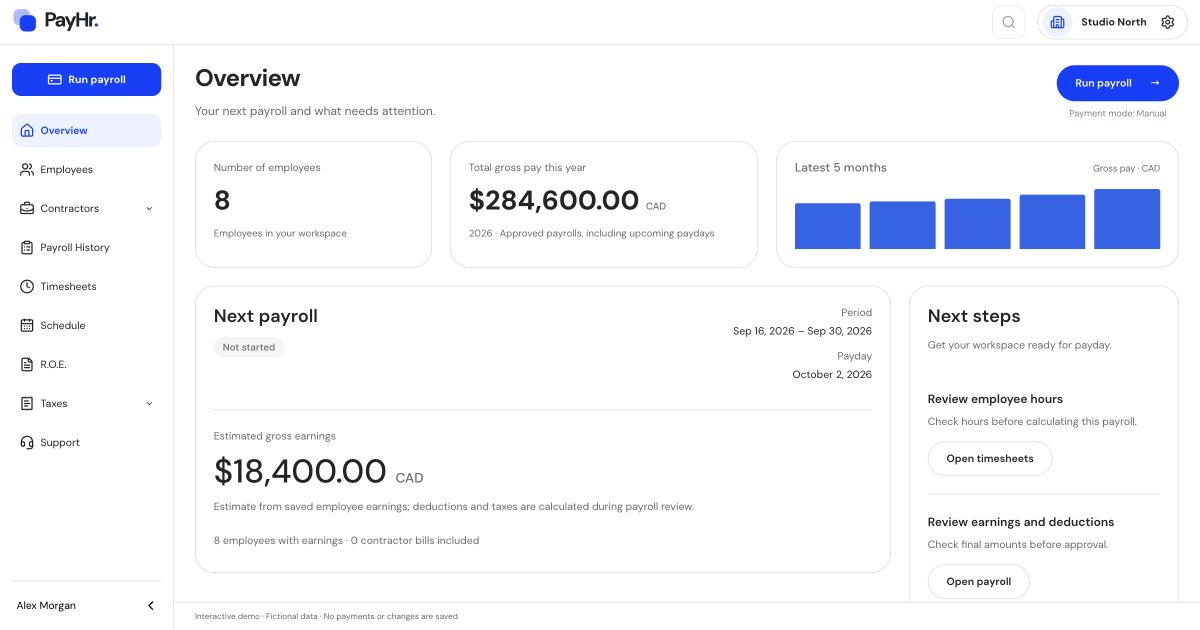
Company news
PayHr introduces a free payroll software plan for Canadian small businesses
PayHr’s Free Plan includes unlimited employees, contractors and pay runs, with optional paid services and coverage in Canadian provinces outside Quebec.
Read the announcement